
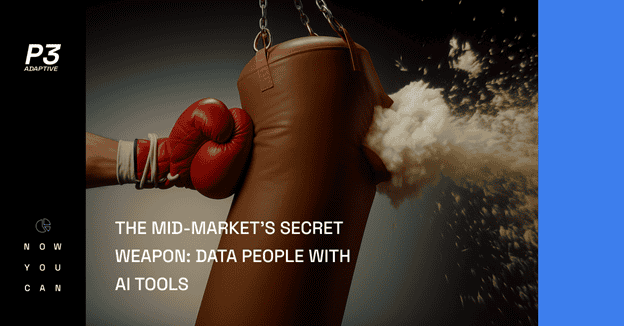
Why Smaller, Scrappier Teams Are Outpacing Enterprise Giants at AI Adoption
Enterprise level companies love to talk about AI strategy. They form a committee, hire a consultancy, buy some shiny tools, and hold a summit about “unlocking potential.” Six months later, they’ve got a slide deck the size of War and Peace and not a single working use case.
Meanwhile, a twelve-person ops team in in a mid-market organization quietly connects Power BI and Microsoft Fabric, drops in Copilot, and builds an AI workflow that cuts two days off every close cycle. No keynote. No six-figure pilot. Just results.
That’s what makes mid-market AI adoption different. The people closest to the problems are the ones solving them. They don’t wait for an enterprise-wide initiative; they open Power BI, fire up Fabric, and start experimenting.
The Underdog Advantage
The mid-market doesn’t have the luxury of “innovation departments.” It has data people—analysts, finance leads, ops managers—who already know where the pain lives. They’ve been duct-taping systems together for years, turning Excel into a mission-critical app, and keeping the lights on through sheer creativity.
Now give those same humans AI-powered tools like Copilot in Power BI or Microsoft Fabric, and watch what happens. Suddenly, they’re:
- Using Power BI and custom patterns to automate manual reports
- Building models that forecast demand instead of guessing it
- Cleaning data automatically with natural-language prompts
- Answering “what-if” questions in seconds, not after weeks of meetings
No million-dollar pilot, no fifteen approvals. Just smart humans with sharper tools.
The data-driven mid-market wins because it moves fast. Every insight gets acted on, every mistake gets fixed in real time. That’s not chaos—it’s evolution at speed.
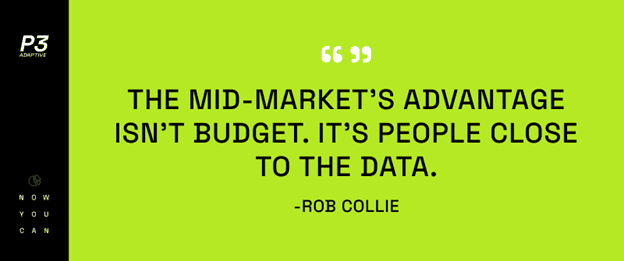
The Enterprise Illusion
Big enterprises like to say they’re “AI-first.” In reality, they’re PowerPoint-first. Every decision passes through six layers of approval and a steering committee that hasn’t opened Power BI since 2019.
By the time a use case clears governance, the mid-market competitor has already built, tested, and iterated three times.
This isn’t about budget. It’s about culture.
Mid-sized organizations can actually see the impact of what they build. When a supply-chain manager uses Power BI to create sales forecasts with shipping data, they don’t need a press release—they just notice fewer stockouts. When a controller uses Power BI and Copilot to reconcile revenue, they free up a weekend.
That kind of progress doesn’t come from a transformation office. It comes from people who know the business and aren’t afraid to get their hands dirty.
Why Data People Are the Real AI Strategy
Most AI conversations start with models, not humans. That’s backward.
Every working AI solution has one thing in common: someone who understood the question before training the model. The best AI tools don’t replace analysts—they amplify them.
In a mid-market data team, one person might be writing DAX, configuring pipelines in Fabric, and a talking to leadership about what the numbers actually mean. They speak both dialects—business and data—and that bilingualism is pure gold.
These are the people turning AI from buzzword to workflow:
- A finance analyst who uses Power BI to explain cash-flow drivers in plain English
- A logistics lead who builds an anomaly detector to flag shipping delays
- A marketing manager who connects advertising data and sales data in Power BI for real-time ROI dashboards
They’re not waiting for the “AI center of excellence” to bless it. They’re doing it because it works.
Fast Beats Fancy
AI adoption doesn’t need to start with a grand strategy document. It starts with a pain point. Automate a forecast. Build a semantic model. Save one team five hours a week.
Then repeat.
That’s the playbook that turns mid-sized organizations into quiet powerhouses. Each small automation compounds until decision-making gets faster, reports get cleaner, and leadership starts trusting the data instead of debating it.
Speed creates credibility. Credibility earns budget. Budget fuels the next round of innovation.
That’s how the cycle really works—not through enterprise software rollouts, but through data-people-led change.
The Power of Foundation
Here’s the irony: the same thing that makes big companies slow could make the mid-market unstoppable.
It’s not about adding more platforms—it’s about getting your foundation right. The smartest mid-market teams start by connecting what they already have: systems, spreadsheets, databases, reports. They turn scattered data into a clean, governed layer that AI can actually use.
That’s where data-savvy humans make all the difference. They know which sources matter, which metrics to trust, and how to build the kind of semantic model that makes AI sound smart instead of confused.
Once that groundwork’s in place, everything else moves faster. Power BI becomes the window into truth, AI becomes a co-pilot instead of a party trick, and decision-making shifts from “wait for a report” to “ask and act.”
It’s not about having a bigger platform—it’s about having a tighter grip on the foundation that fuels every smart move. That’s the mid-market’s real equalizer: clarity, speed, and data people who know exactly where to aim.
The Takeaway
AI doesn’t replace your people—it amplifies them. And in the mid-market, that’s everything.
Because your best people already know where the inefficiencies live. They’ve been patching gaps with spreadsheets and intuition for years. Now they have tools that turn those hacks into sustainable systems.
You don’t need a fully funded tech research lab to win with AI. You need data-driven teams with room to move and the right foundation underneath them.
If you’re a mid-market leader wondering how to keep up with the goliaths, here’s the good news: you already have the secret weapon. It’s your people—and the AI tools that let them work at the speed of thought.
Ready to see how fast your data people can move with AI-powered tools?
Let’s make it happen.

Get in touch with a P3 team member