
What the BI Ramp-Up Taught Us About AI Implementation
Nobody panics when a new VP needs ninety days to find their footing. Nobody fires the analyst who spent their first month learning which reports actually matter. We understand that smart people need context before they can perform.
And then we turn around and hand AI a six-figure implementation budget, give it two weeks to prove itself, and declare it broken when it doesn’t immediately transform how the business runs.
The problem isn’t the AI. It’s the expectation we walked in with.
Expecting AI to be perfect on day one is one of the most expensive mistakes companies are making right now. Not expensive in a dramatic, headline-grabbing way. Expensive in the quiet way – the shelved project, the lost momentum, the executive who championed the initiative and is now very carefully not mentioning it in meetings.
That’s the hidden cost of AI implementation. And it’s completely avoidable.
We’ve Seen This Before
Think back to the early days of self-service BI. The promise was enormous. Put the data in front of the people who need it, let them build their own views, and watch the insights flow.
What happened instead? Reports that took seventeen clicks to run. Dashboards that didn’t match. Business users who asked for “all the data” and then promptly drowned in it. And a whole lot of frustrated IT teams who got blamed for something that was really just a ramp-up problem masquerading as a technology failure.
The tool wasn’t broken. The expectations were. We expected day-one polish from something that needed configuration, curation, and context-building to deliver real value. Once organizations figured that out, they slowed down to go fast. They scoped the first deployment. They defined success narrowly. They iterated.
Power BI didn’t get good overnight. It got good because smart teams gave it the right inputs, asked it manageable questions first, and built up from there.
We are watching the exact same movie with AI, just with a bigger budget and a shorter attention span.
What “Perfect on Day One” Actually Costs You
Let’s talk about what really happens when the expectation bar is set at “immediately transformational.”
The first thing to go is the project itself. When AI doesn’t dazzle in the first demo, someone in the room decides the technology isn’t ready. The initiative gets deprioritized. Budget gets reallocated. The team that was quietly excited to try something new goes back to their spreadsheets.
The second thing to go is organizational trust. You told your leadership team this was worth investing in. When it doesn’t perform the way you described, you’ve now got a credibility problem that has nothing to do with the quality of the technology. You set the bar. The bar wasn’t met. That’s on the expectation, not the tool.
The third thing to go is competitive ground. While you’re debating whether AI “works for your industry,” other companies are running their thirtieth iteration, learning from thirty rounds of feedback, and getting genuinely good results. They didn’t start with a perfect outcome. They started with a clear first question and built from there.
None of this is dramatic. It’s just slow, quiet, expensive drift in the wrong direction.
AI Doesn’t Know Your Business Yet. That’s Normal.
Here’s the thing people don’t say enough: AI doesn’t walk in the door knowing anything about your company. It doesn’t know your terminology. It doesn’t know that “closed” means something different to your sales team than it does to your finance team. It doesn’t know which numbers your CEO trusts and which ones she quietly ignores.
It’s a new hire. A very capable, very fast new hire – but a new hire nonetheless.
And you wouldn’t hand a new hire the keys to your most critical process on day two and then write them up when something goes sideways. You’d onboard them. Train them. Give them context. Let them build reps on real problems that have some room for error. You’d set them up to succeed before you measured whether they were succeeding.
AI implementations need the same logic applied to them. Not because it’s fragile. Because intelligence – human or artificial – requires context to perform well. The model doesn’t come pre-loaded with your business. You have to bring it. And that takes time, intentional design, and realistic expectations about what “good” looks like at each stage.
The companies getting real ROI from AI right now aren’t the ones who went all-in immediately and got lucky. They’re the ones who scoped their first use case tightly, defined what success looked like before they started, and treated the first deployment as the beginning of a learning loop rather than the finish line.
What Intentional AI Adoption Looks Like
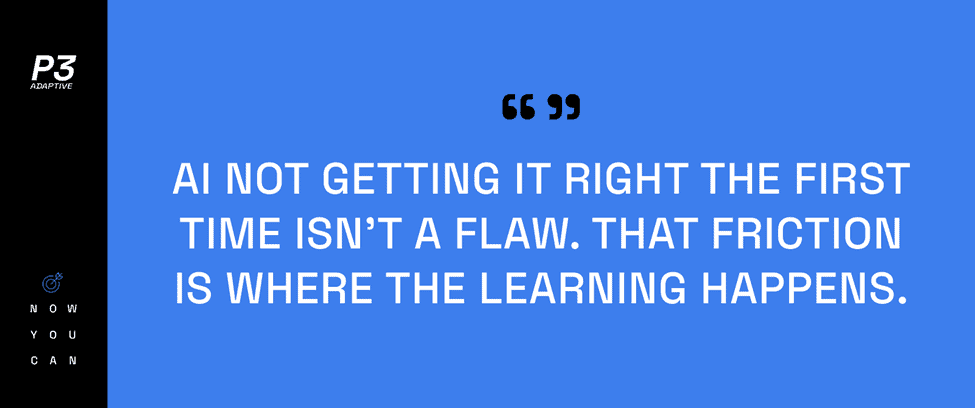
Small wins compound. That’s not a motivational poster sentiment. It’s how this actually works.
Start with one question you genuinely need answered. Not the most interesting question, not the most transformational question – the most answerable one given your current data. Get that right. Build confidence. Build process. Then expand.
Make sure the data feeding the AI is clean and organized before you complain that the AI isn’t performing. This is not a pleasant thing to hear if you’ve just spent a month on an AI initiative, but it’s true. Garbage in, garbage out was true in 1985 and it’s still true today. The AI isn’t broken. The inputs need work.
Define success criteria before you start, not after. “We’ll know it’s working when…” is a sentence you need to complete before the first deployment, not when you’re already in the post-mortem. Vague success criteria are how good AI projects get killed by unrealistic gut reactions.
Build feedback loops early. The first version of anything AI-powered should have human review built into it. Not because you don’t trust the technology, but because you’re still teaching it your world. The review process is the onboarding. Skip it and you skip the learning.
None of this is slow. It’s how you actually go fast without burning down the runway.
The Real Competitive Advantage Is Patience (The Useful Kind)
There’s a version of patience that’s just procrastination with better PR. That’s not what this is.
The patience that matters here is the discipline to define a small, clear starting point instead of a sprawling ambition. It’s the willingness to call a three-week pilot a success when it answered one question well, even though it didn’t change the entire company. It’s the organizational maturity to say “we’re learning” and mean it in a constructive way rather than as a polite cover for “we’re stalling.”
That kind of patience compounds. The organizations that get this right in year one are the ones running circles around everyone else in year two. Not because they had better technology. Because they knew how to use it well, and they built that knowledge through intentional, unglamorous iteration.
An AI implementation isn’t going to be perfect on day one. But it can be genuinely useful on day one if you ask the right question, give it the right inputs, and resist the urge to declare the experiment over before it’s had time to breathe.
The companies figuring this out right now aren’t waiting for perfect. They’re building toward it.
We’ve onboarded a lot of AI new hires. We know what the first ninety days should actually look like and we can have yours running in two weeks.
Get in touch with a P3 team member