
The hidden pattern behind the projects that actually get adopted
You can learn a lot about an AI project by asking one simple question.
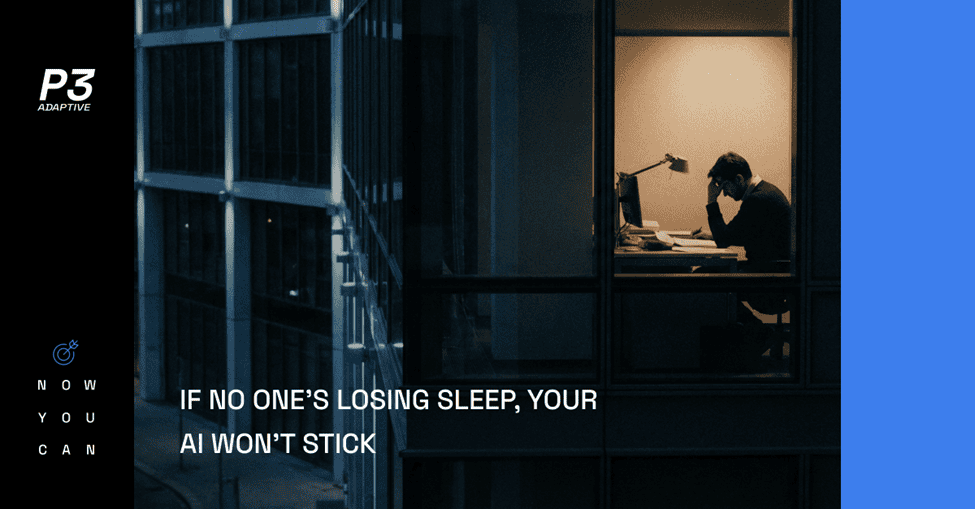
Who’s losing sleep over the problem?
If the answer is nobody, there’s a good chance the project won’t stick. Not because the technology is weak, but because the motivation isn’t there yet.
AI projects fail most often when the people experiencing the problem aren’t involved in building the solution.
There is a clear pattern in the AI projects that actually get adopted and the ones that quietly fade away after the demo. Most organizations assume an AI adoption strategy starts with picking the right model or the right tools. In reality, the projects that succeed usually start somewhere much more human.
Someone close to the problem decides they’re done living with it.
Why Do Most AI Projects Fail?
Most AI projects fail because the people experiencing the problem were never part of building the solution. When AI tools are introduced without a real operational pain behind them, they feel optional instead of necessary. Even impressive technology struggles to gain traction if nobody’s daily work improves because of it.
Successful AI implementation usually starts the opposite way. Someone close to the problem helps shape the solution, and the tool fits naturally into the work they were already doing.
The Pattern Behind AI Adoption
AI adoption usually succeeds when the person experiencing the problem helps shape the solution. When the tool removes friction from someone’s real work, it becomes part of the workflow instead of another optional experiment.
The Projects That Stick Start the Same Way
Think about the business tools people still use months after their introduction. Not the ones that impressed everyone during a conference room demo, but the ones someone quietly shows a new hire during their first week because “this is how we do things here.” Those tools almost always started with someone who lived the problem every day.
Not someone who spotted an interesting opportunity. Someone who felt the friction personally. They knew where the work slowed down, where the manual effort piled up, and where every workaround felt like duct tape holding the process together.
That proximity changes how solutions get built. When you know the problem from the inside, you stop chasing clever ideas and start building something that actually helps.
The Tool We Built That Nobody Needed Yet
We learned this lesson the hard way.
Justin spent real time in the Batcave building an internal AI agent designed to help our consulting team explore AI opportunities with clients. The idea was both simple and compelling. Capture Justin’s thinking about AI and make that expertise available to the entire consulting team.
In theory, every consultant could walk into a client conversation equipped with the same depth of perspective.
The technology worked beautifully. The adoption didn’t.
The consulting team simply wasn’t waking up every day thinking they needed help thinking about AI. That wasn’t the pain they were feeling. So, when the tool appeared, it landed as another task on the to do list instead of something that made their work easier.
People still found uses for it. Quick support. On brand responses. Helpful things. But it never became the transformation originally imagined.
Why AI Adoption Strategies Break
A lot of people assume AI adoption breaks down because of technical issues. Maybe the model hallucinates. Maybe the integrations are messy. Maybe the results aren’t perfect.
Those things matter, but they rarely explain why a project never takes hold.
The more common failure point is the human system around the technology. The tool arrives, but the people expected to use it don’t feel an immediate reason to change how they work. When that happens, the tool becomes optional.
And optional tools rarely become habits.
That’s the quiet failure mode behind many enterprise AI implementation efforts.
The School of Fish Problem
AI creates another challenge for organizations. Suddenly every workflow looks like a candidate for automation. Every department has ideas. Every process feels like it could be improved.
Instead of watching one or two fish swim by, you’re staring at an entire school.
When that happens, the instinct is to chase everything at once. Give everyone access to AI tools. Launch a dozen experiments and see what works. It feels productive in the moment.
But it’s a little like opening twenty browser tabs when you’re trying to solve one problem. Your attention spreads everywhere and the real work slows down.
The smarter move is narrower:
Start where someone is already losing sleep.
Faucets First Applies Here Too
At P3 we talk a lot about Faucets First. Build something useful people can actually put their hands on. Once that faucet exists, real usage quickly reveals which pipes behind the scenes need attention.
The same idea applies to AI adoption strategy. The goal is not to disappear into a strategy bunker and emerge months later with a system nobody asked for. The goal is to solve a real pain for a real person, get the tool into use, and let that experience guide the next improvements.
That is what creates momentum. Once people see value, the next steps become obvious.
What Is an AI Adoption Strategy?
An AI adoption strategy is the process of identifying real operational problems, building AI solutions with the people experiencing those problems, and integrating the tools into everyday workflows so they become habits instead of optional experiments.
Successful AI change management starts with understanding the human side of the work. When the solution directly improves someone’s daily responsibilities, adoption happens naturally. When that connection is missing, even powerful tools struggle to gain traction.
That’s why the most effective AI strategies start with people rather than technology.
The Setup Work That Makes AI Stick
This is the work some organizations skip because it doesn’t look like “doing AI.”
Start by understanding the real problems people deal with every day. The manual tasks that quietly eat hours. The decisions that stall because nobody can get to the right information quickly. The workflows that seem fine on the surface but are constantly patched with workarounds.
Then connect the solution to the people living that reality. When the benefit shows up clearly in someone’s day to day work, adoption tends to take care of itself.
When it doesn’t, no amount of excitement about AI will change the outcome.
What This Means for Your AI Strategy
Organizations can begin by asking where AI could be used.
A stronger starting point is simpler. Where does the work hurt today? Where are smart people burning time on tasks that shouldn’t require that much effort? Where does friction quietly slow down the business?
Answer those questions first. Then look at how AI could help.
That shift turns AI from an interesting experiment into something the business actually uses.
The Manual Page
Every AI project worth building starts with someone who can’t stop thinking about the problem.
Find that person. Build with them first.
AI adoption rarely fails because of the technology. It fails because the human problem was never clear enough or well defined enough.
The best AI projects start with a real problem in the room. Someone who understands the friction because they’ve been living with it for a while.
If nobody’s losing sleep yet, that’s fine. The opportunity just hasn’t shown itself clearly.
But when someone finally says, “We can’t keep doing this the hard way,” that’s usually where the interesting AI work begins.
If that conversation is happening inside your organization, we should talk. We’d be glad to help you work through it.
Get in touch with a P3 team member