
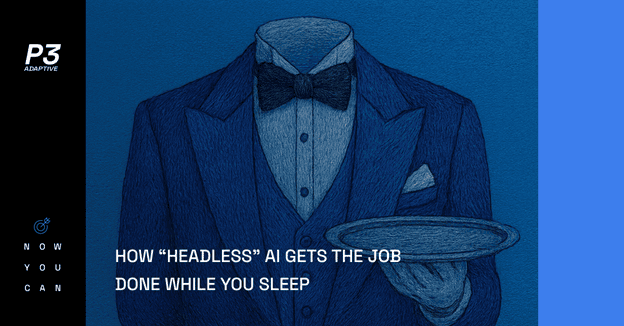
Headless AI: Where The Real Transformation Happens After Everyone Logs Off
Everyone’s losing their minds over chatbots that can write your emails, summarize your meetings, and promise to “save you time.”
Meanwhile, the AI that’s actually saving companies millions?
It flies under the radar.
The best AI isn’t the one that talks back, it’s the one that quietly fixes things while you sleep.
While the spotlight stays on chatbots and copilots, the smart companies are investing in something far more valuable: Headless AI: the kind that runs the business behind the scenes.
No interface. No fanfare. Just relentless, invisible work that compounds into competitive advantage.
Here’s what nobody tells you about AI transformation:
The flashy stuff gets the applause.
The quiet stuff gets the results.
What Is Headless AI?
Headless AI is business process automation that doesn’t need an interface or an audience.
No chat window. No dashboard. No buttons to click.
Just logic, routing, and execution happening automatically while your systems talk to each other.
Think of it as your business’s nervous system.
When you touch something hot, your hand pulls back before your brain even processes what happened. That’s not you being clever. That’s your wiring doing its job.
Headless AI works the same way. It connects your systems, watches for signals, and acts the moment something starts to go wrong.
It’s not glamorous. It’s just effective.
Where does this show up? Everywhere that matters and nowhere you’d demo it:
- Finance reconciliations that fix themselves overnight
- Supply chain adjustments that happen before anyone notices a delay
- Alerts that escalate to the right person at the right time
- Forecasting tweaks that reflect yesterday’s actuals before you’ve poured your first coffee
This isn’t the AI that dazzles in meetings.
It’s the AI that makes those meetings shorter because half the fires are already out.
Why Headless AI Wins: The Case for Invisible Work
Here’s what makes Headless AI so very effective: it never gets tired, distracted, or forgets a step.
You know that overnight data load that failed at 2 a.m.? The one nobody noticed until 9:30 when finance needed the numbers?
Headless AI would’ve caught it at 2:01, triggered a retry, and sent an alert if it couldn’t self-heal. By the time you’re pouring your first coffee, the problem’s already solved.
Or those vendor payment alerts that should go out three days before they’re due? A human has to remember to check, pull the report, review the list, and send the emails.
Headless AI just does it. Every time. Without fail. At exactly the right moment.
This is where AI automation stops being theoretical and starts compounding real value.
While your competitors are still manually triaging their morning email disasters, your systems have already:
- Updated forecasts based on overnight sales data
- Triggered alerts for inventory items hitting reorder points
- Adjusted production schedules based on material delays
- Flagged anomalies in transaction patterns for fraud review
It’s like having a night shift that never complains, never forgets, and never asks for coffee.
Except unlike a night shift, it scales infinitely and costs a fraction as much.
Where It Shows Up in the Real World
Let’s get specific about where Headless AI delivers automation that actually moves numbers.
Finance: Your AP team walks in Monday morning and the weekend’s invoices are already matched to POs, flagged for approval, or queued for investigation if something’s off. Late payment warnings went out automatically Friday afternoon. Month-end accruals? Already calculated based on patterns from the past six closes. Nobody stayed late. Nothing got missed.
Operations: A shipment gets delayed. Before anyone reads the email, your system’s already identified affected orders, recalculated delivery dates, triggered customer notifications, and rebalanced warehouse picks to prioritize what can still ship on time. The ops manager finds out about the delay and the solution simultaneously.
Manufacturing: Yesterday’s machine utilization data shows a pattern suggesting maintenance is due soon. The system doesn’t wait for someone to spot it in a report — it adjusts the production schedule, orders the parts, and updates the maintenance calendar. By the time the machine would’ve failed, it’s already serviced.
None of this replaces people. It prepares them.
Your team walks in with problems already triaged, decisions pre-staged, and busywork handled. They spend their day on judgment and creativity, not mechanical cleanup.
Why You Don’t Hear About It
Headless AI has a PR problem: it’s not demo-friendly. You can’t show it in a keynote. There’s no slick interface to screenshot for LinkedIn. It doesn’t generate the “wow” moment that gets budget approved.
But that’s exactly why it works.
Headless AI isn’t built for recognition, it’s built for reliability. It’s the difference between AI as a parlor trick and AI as critical infrastructure.
When’s the last time you got excited about your electricity working? Never, because it just works.
That’s what adaptive intelligence in the background should feel like: boring, dependable, and absolutely essential.
Headless AI doesn’t make slides. It makes progress.
While everyone else chases the next viral demo, the companies actually winning are building invisible automation that runs whether anyone’s watching or not.
They’re not trying to impress their competitors They’re outpacing them by making better decisions faster, with less friction.
This is what adaptive intelligence looks like in motion. AI that doesn’t just answer questions, it helps runs the business.
Building It the Right Way
Here’s the catch: Headless AI only works if your foundation does.
You can’t automate chaos. You can’t bolt AI onto bad data and call it transformation.
You need semantic models that reflect how your business actually works, clean data that systems can trust, and logic that handles exceptions without human babysitting.
That’s where most AI projects go wrong. They start by rebuilding the plumbing.
We start by turning on the faucet and proving it works.
The adaptive intelligence approach is different: small, connected systems working together instead of one massive “AI brain” that tries to do everything.
Your inventory system talks to your forecast.
Your forecast talks to your production schedule.
Your production schedule talks to procurement.
Each piece is simple, testable, and reliable. Together, they create compound intelligence that gets smarter over time.
The results don’t show up as one dramatic moment. They accumulate quietly: time saved here, errors avoided there, smoother mornings, fewer fire drills, better context for every decision.
Six months in, your team is running twice as fast without feeling like they’re sprinting.
That’s not AI hype. That’s automation that actually works.
The AI That Lets You Sleep
Here’s the downside of all those flashy AI assistants everyone’s building: they’re still asking for your attention.
They help you do work faster but they don’t do the work.
Real transformation happens when your systems handle the mechanical overnight while you actually sleep — when you wake up to a business that’s already adjusted, already updated, already ready.
That’s not replacing human judgment. It’s multiplying it by removing the friction that slows it down.
So ask yourself: what could your “night shift AI” be doing for you right now?
What decisions are formulaic enough to automate?
What alerts should trigger automatically?
What adjustments could run based on patterns instead of waiting for a meeting?
The companies pulling ahead aren’t the ones with the flashiest demos.
They’re the ones whose systems never stop working.
Ready to stop babysitting your data?
We help mid-market leaders build adaptive intelligence that runs the business while they focus on growing it, starting with quick wins in weeks, not “transformations” measured in years.
Let’s talk about what your systems could be doing while you sleep.
Get in touch with a P3 team member