
The Real AI Gap Isn’t Technical. It’s Operational.
The frustrating part about AI right now isn’t that it can’t do enough.
It’s that most organizations aren’t using what’s already possible.
Teams are stuck in strategy sessions. Procurement cycles. Vendor negotiations that stretch for months. Meanwhile, the workflow they’re debating could be running next week.
Not kind of working. Not a prototype. Actually running. Solid. Robust. Delivering value.
What if the timeline between “we need this” and “it’s working” was far shorter than anyone expected?
What the Capability Overhang Actually Is
Justin Mannhardt introduced this term on a recent Raw Data with Rob Collie episode, and it’s been stuck in my head ever since. The capability overhang is the gap between what AI can do right now and what most organizations are getting out of it.
That gap represents pure opportunity.
The technology keeps advancing, and it’s advancing faster than most organizations are adopting new ways to use it. You don’t need to wait for the next model. What’s here now is already capable.
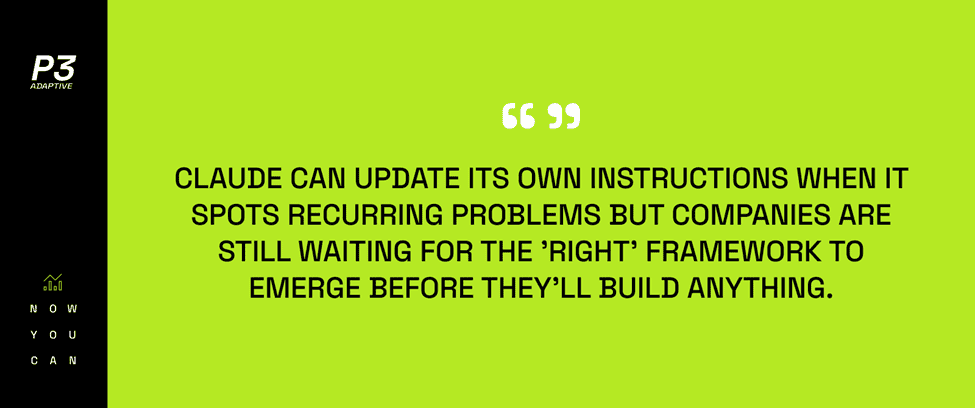
Claude Opus 4.6 can now update its own instructions when it spots recurring problems. Not on a roadmap. Not “coming soon.” Live right now.
But the real story isn’t that the model can do something clever. The real story is what that enables inside your business. When tools can adapt midstream, workflows that once required human babysitting can become more resilient. Iteration speeds up. Friction drops.
That’s the kind of capability sitting there, ready to be applied to real operational work.
The companies capturing value right now are using what’s already available instead of waiting for what’s next. They’re moving forward with custom AI implementation today rather than designing theoretical systems for tomorrow.
The Framework Landscape Is Fine
Everyone’s releasing agent frameworks now. Every major AI player has one. Some have more than one.
It looks chaotic from the outside.
But from the perspective of actually building real systems, the framework you pick matters far less than most people think.
What matters is whether it solves your actual problem. Whether you can build something this week. Whether you’ll learn something by watching it work in your real workflows with your real people.
You don’t need six months of architecture planning. You need something that works well enough to teach you what “good enough” means in your environment. Then you rebuild it when the models get better. Because they will.
The abundance of options isn’t paralysis. It’s permission to start.
Who’s Capturing Value Right Now
The companies winning with custom AI implementation right now are the ones who built something, watched it work, learned what was possible, and moved on to the next opportunity.
They didn’t wait for perfect. They didn’t wait for a built-in enterprise package. They turned it on and started learning and that learning compounds.
The teams climbing that curve now are building institutional knowledge about where AI adds leverage in their specific business and where it doesn’t. That knowledge becomes a competitive advantage over time.
The Simpler Path to Value
Remember in Die Hard when they’re trying to shut down the power grid? Bigwigs standing around talking about authorization, bureaucracy, and how long it will take.
Then there’s the guy down in the manhole waving his hands. “I can do it right here.”
Sometimes there’s a simpler path that gets you to value faster.
That workflow you’re planning could be running next week. Not a prototype. The actual thing. You would learn more from running it for a month than from another six months of planning meetings.
The Opportunity in Front of You
The capability overhang represents opportunity. A lot of it.
Yes, the models keep improving. But you don’t need to wait for better models to start getting value from the ones we have now.
The frameworks are good enough. The models are capable enough. Your workflows, your edge cases, your operational complexity can be addressed with thoughtful custom AI implementation today.
Companies that build something this week and learn from it are developing capabilities that compound over time. The earlier you begin, the more institutional knowledge you build.
We build custom AI systems fast. The kind you can run in weeks, not quarters.
If you’ve been planning something that could be running by Friday, let’s talk.
Get in touch with a P3 team member