
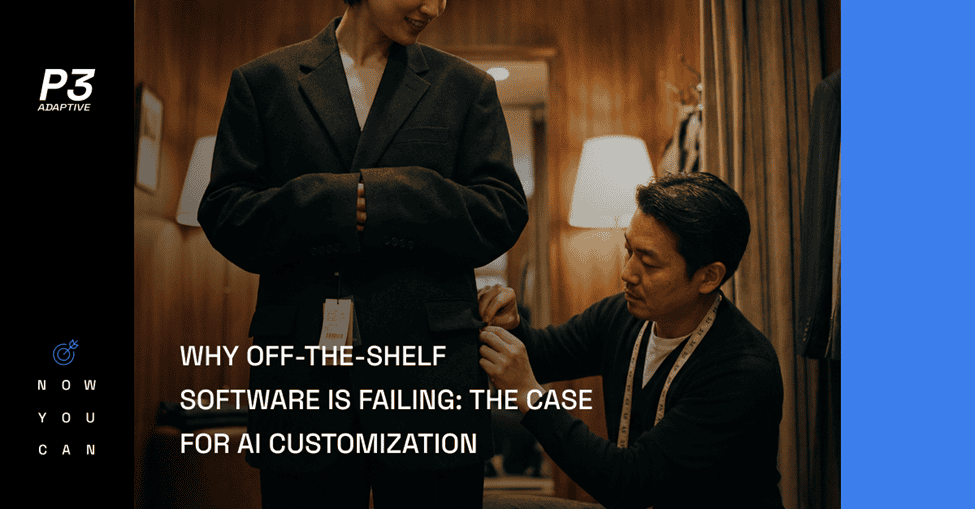
Why Off-the-Shelf Software Is Failing
Your CRM tracks deals beautifully. Reports make zero sense.
Your ERP runs operations. Can’t answer basic questions without consultants.
Your finance system does accounting. Analyzing trends means Excel and prayer.
For years we accepted this. Custom software meant six figures and timelines measured in quarters. That acceptance just ended.
The same pattern keeps repeating. It happened with reporting. Then AI. Now it’s the software itself. If you’re trying to figure out where AI creates value, understanding this pattern matters more than any benchmark you’ll see this year.
Built-In Reporting Rarely Worked
Line of business systems make the machine go. Salesforce manages pipelines. Your ERP processes orders. Finance platforms close books. They’re phenomenal at operational tasks. That’s why you bought them.
The moment you need to understand what’s happening across your business? Friction.
Built-in reports are designed for a generic company that doesn’t exist. They’re siloed when your questions span systems. They update on schedules that don’t match your needs. Customizing them means begging vendor services teams or learning a proprietary builder designed by someone who hates users.
We learned the answer years ago. Separate analytics from operations entirely. Power BI proved you could pull data from everywhere, model it how your business thinks, and build reports that answer real questions. That separation worked because it acknowledged truth: people who build operational software optimize for different goals than people who need to understand the business.
Off-the-Shelf AI Doesn’t Work Either
AI showed up. We learned the same lesson again.
ChatGPT is incredible for general tasks. Write emails. Brainstorm. Explain concepts. But try using it for something specific to your business? Falls apart.
It doesn’t know your data. Doesn’t understand your terminology. Can’t access your systems. Definitely doesn’t know the seventeen exceptions that make your business different from every other business in your industry.
AI customization isn’t a nice-to-have. It’s the entire point.
An AI that can’t see customer history can’t help sales. An AI that doesn’t understand your product catalog can’t assist inventory decisions. An AI that can’t integrate with workflows creates more work, not less. This is why business AI customization matters. Not as luxury. As baseline requirement for tools that work.
The tools that impress in demos get abandoned three weeks after launch. Everyone realizes they can’t do the job.
This should sound familiar. Same reason you can’t rely on CRM reports. The tool is designed for everyone, optimized for no one. We separated analytics from operations because generic reporting failed. Off-the-shelf AI fails the exact same way. Same reasons.
Now It’s the Software Itself
Here’s where it gets interesting.
Rob needed to analyze his wife’s health data. Years of symptoms tracked in Power BI. Trying to find patterns and correlations that might explain what’s happening. This isn’t theoretical. This is someone you love dealing with health issues that doctors can’t explain.
Apple Health exists. Garmin exists. Dozens of biomarker tracking apps exist. Built by well-funded companies with smart teams designing for millions of users. None could do what he needed.
So he sat down and using Claude Code he built it.
Ran correlation analysis across variables. Pulled seven years of workout history via API from Orangetheory. 150 data points per workout session. Set up filters to distinguish power walking from running based on speed thresholds. Caught the AI when it tried to treat blank cells as zeros. Spotted backwards correlations. Dug deeper to figure out actual causal relationships.
Built something that understood the exact problem instead of approximating it.
Two years ago this required hiring developers. Writing specifications. Managing months-long projects. Now it’s a Tuesday afternoon.
The economics changed. Not gradually. Suddenly.
When AI customization becomes faster and cheaper than configuring off-the-shelf products, the entire software market shifts.
What This Means for Your Stack
Think about your software stack. Every tool you’re paying for monthly was designed for thousands of companies with different workflows, different priorities, different exceptions. You’re constantly working around assumptions baked into those products.
Explaining to new employees why we do it “this way” instead of the way the software wants. Building spreadsheets outside the system because the system can’t quite capture what you need. Waiting for vendors to add features you requested eighteen months ago.
Off-the-shelf made sense when the alternative was impossible. But when someone with the right skills can build exactly what you need in the time it takes to sit through a vendor demo, the math changes completely.
You’re not choosing between cheap-and-generic versus expensive-and-custom anymore. You’re choosing between software that sort of works versus software that fits.
The people who can build these solutions need what Rob calls the data gene. They understand problems well enough to know when an answer is wrong. They spot backwards correlations before they become bad decisions. They think in systems and patterns.
Not everyone has this. But way more people have it than traditional gatekeepers admit. It’s not about credentials or titles. It’s about how you think and whether you can catch an AI when it confidently tells you something that doesn’t make sense.
What AI Customization Actually Means
Most companies will miss this completely. They’ll keep renewing SaaS subscriptions for tools that create as much friction as they solve. They’ll wait for vendors to add features that never arrive. They’ll accept “this is just how the software works” when software should work how their business works.
A smaller group will figure out the economics changed. They’ll identify who on their team can build. They’ll ask “could we build this ourselves?” before automatically reaching for vendor marketplaces. They’ll realize the off-the-shelf budget that made sense five years ago now looks questionable compared to what’s possible with custom AI implementation.
This isn’t about abandoning every SaaS tool. Your operational systems still need to make the machine go. But the layer on top? The parts that need to fit your specific business, your workflows, your way of thinking about problems? That’s where AI customization creates value generic products can’t touch.
The question isn’t whether this shift is happening. It’s whether you’ll act while there’s still advantage to moving early. Or wait until your competitors already did.
If you’re ready to figure out where AI customization creates real value in your business and who on your team can build it, let’s talk. We help mid-market leaders move from vendor demos to implementations that ship.
Get in touch with a P3 team member