
Why Good Ideas Stay Invisible
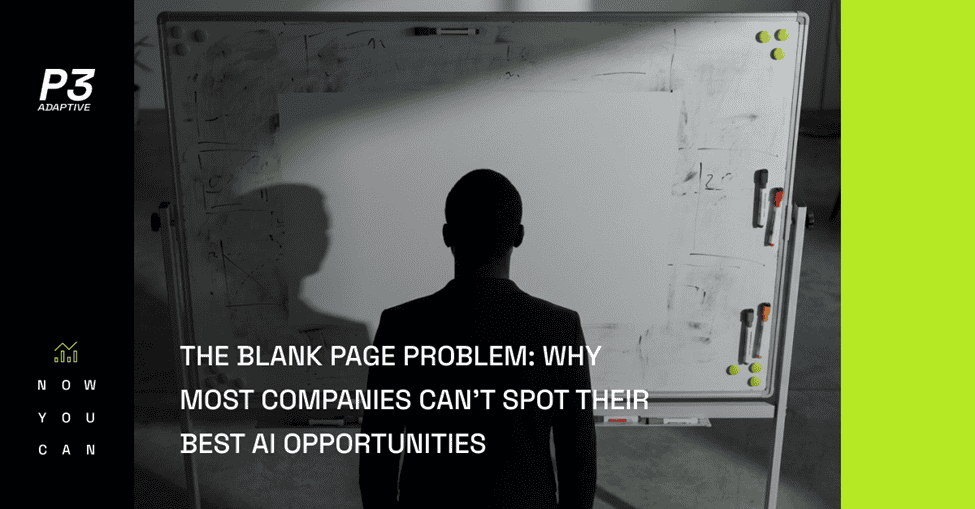
Your team sits in a conference room. Someone writes “AI Strategy” on the whiteboard. Then someone asks: “So where should we use it?”
Silence.
Not because anyone lacks ideas. Because you just asked them to invent answers on the fly for tech they haven’t’ used in business before.
No examples. No pattern. No idea what right looks like.
This is the blank page problem. And it kills more AI initiatives than bad technology ever will.
The Invisible Pain Problem
Here’s what makes AI opportunities so hard to spot: the worst problems in your business don’t feel like problems anymore.
You’ve lived with them so long they became normal.
That manual process your finance team runs every month? Takes three days. Involves six people copying data between systems. That’s not a problem. That’s just “how we close the books.”
That customer question your support team answers 47 times a week? Not a problem. Part of the job.
The insight your VP keeps requesting that takes your analyst two days to pull? Also not a problem. Just “the way things work.”
Pain you’ve always lived with becomes invisible. And invisible pain can’t become an AI opportunity because nobody thinks to mention it.
The Things That Aren’t Happening Problem
There’s a worse version of this.
The easiest problems to spot are the ones happening poorly. The broken process. The slow report. The manual task that shouldn’t be manual.
But the best AI opportunities? They’re often things that aren’t happening at all.
Nobody’s asking “what if we could predict which customers will churn next quarter?” You’ve never been able to predict it. Nobody’s saying “we should automate supplier risk analysis” because you’ve never done supplier risk analysis.
You can’t miss what you’ve never had.
This is why the blank page problem is so brutal. You’re not just asking people to identify pain. You’re asking them to imagine capabilities that don’t exist yet.
Without examples, that’s nearly impossible.
Why Examples Are the Only Real Answer
You know what changes everything? Seeing one good example.
Not a vendor pitch. Not a whitepaper. A real example of AI doing something useful in a context that feels familiar.
Take Haystack. We built an AI system that reads construction invoices, extracts the data, matches it against contracts, and flags discrepancies. Sounds simple. But here’s what makes it a great example: before you see it, you don’t think “we need AI for invoice processing.” After you see it, you start wondering what else could work the same way.
That’s pattern recognition building in real time.
One example gives you a lens. You start seeing similar shapes in your own operations. “Wait, we have a process like that in procurement.” “Our month-end close has the same structure.” “Could we do this with expense reports?”
Examples aren’t inspiration. They’re training data for your brain.
The Framework: Three Questions That Work
If you want to spot AI opportunities without staring at a blank page forever, start here:
1. What tasks involve reading, categorizing, or extracting information from documents or emails? AI is exceptionally good at this. Invoice processing. Contract review. Customer inquiry routing. Compliance document analysis.
If someone on your team spends hours reading things and deciding what they mean, that’s a signal.
2. What questions do your executives ask repeatedly that take days to answer? Not because the data doesn’t exist. Because pulling it together requires someone to manually gather inputs from five systems, reconcile mismatches, and build a summary.
That’s an AI opportunity hiding in plain sight.
3. What would you do if you had perfect information about the future? This one unlocks the “things that aren’t happening” category.
If you knew which deals would close, which customers would churn, which suppliers would have delays, what would you do differently? Now work backward. What signals exist today that might predict those outcomes?
That’s where AI lives.
Why This Still Feels Hard
Even with examples and frameworks, this is genuinely difficult.
AI opportunities don’t announce themselves. They hide in the gap between “how things work now” and “how things could work.”
And most people are too busy keeping things running to spend time imagining different ways of running them.
That’s not a criticism. That’s reality.
You can’t see the opportunity while you’re drowning in the work the opportunity would eliminate.
This is why outside perspective matters. Not because consultants are smarter. Because they’re not numb to your pain yet. They can still see the things you stopped noticing years ago.
Start Somewhere Small
You don’t need to transform your entire business overnight.
Start with one annoying, repetitive task. The thing someone on your team does every week that makes them sigh when it shows up on the calendar.
Ask: could AI do this?
Not “could AI do this perfectly.” Could it do it well enough to be useful?
If the answer is yes, you just found your first opportunity. Build that. Learn from it. Let it train your pattern recognition for the next one.
Small moves lead to big outcomes.
The Real Work Starts After You Spot the Opportunity
Seeing the opportunity is step one. Building it is where most companies stall out.
AI projects need clean data, clear scope, and someone who understands both the business problem and the technology well enough to connect them. That’s not common.
But that’s a different problem. And it’s a better problem than staring at a blank page wondering where to start.
If you’re ready to start building, let’s talk. We help mid-market companies spot real AI opportunities and turn them into working solutions fast.
Get in touch with a P3 team member