
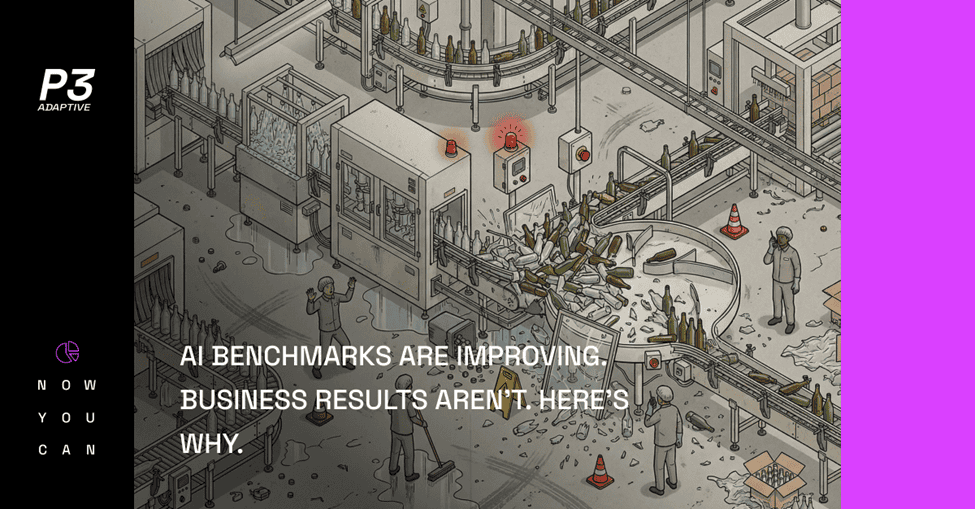
Here’s Why.
AI benchmarks are getting better fast. Every week brings higher scores, cleaner charts, and louder claims that the latest model is a breakthrough. On paper, it all looks like undeniable progress. And yet, when companies put AI in front of real business work, the results often feel underwhelming. Pilots stall. ROI stays fuzzy. Leaders look at impressive demos and wonder why nothing meaningful seems to change.
That gap isn’t mysterious. The models crossed the “magic enough” line a while ago. What’s holding AI back now isn’t intelligence. It’s everything wrapped around it.
Benchmarks answer a narrow and very specific question: how well does this model perform a defined task in isolation? That’s useful information, but it’s not the question businesses are trying to answer. Organizations don’t operate in clean, controlled environments with perfect inputs and shared understanding. They operate with messy data, conflicting definitions, unclear decision ownership, and workflows that don’t reliably connect insight to action.
This is why better benchmark scores so often fail to translate into better outcomes. Not because the benchmarks are wrong, but because they stop short of the parts that actually determine value. Benchmarks measure capability in a vacuum. Businesses operate in gravity.
The Benchmark Trap
For most business use cases, the uncomfortable truth is that the models themselves are no longer the limiting factor. Today’s AI can summarize, classify, detect patterns, and interact in natural language well enough to be useful. When initiatives stall, it’s rarely because the wrong model was chosen. It’s because inputs are unclear, definitions aren’t trusted, or outputs land in places where no one is quite sure what to do next.
Where AI really breaks down is in areas no benchmark measures. It breaks when the same metric means different things in different systems, when outputs don’t map cleanly to real decisions, or when people are expected to “just know” whether an answer is safe to act on. It also breaks when there’s no workflow designed to absorb the output, no owner accountable for acting on it, and no feedback loop to improve results over time.
That’s not an intelligence problem. It’s a structure problem. And structure never shows up on a leaderboard.
This is also why upgrading models so often feels productive without changing anything that matters. A new release drops with better scores, hope spikes, and teams rush to upgrade. But nothing meaningful improves, because the upgrade didn’t touch business logic, definitions, workflows, or accountability. Swapping models without fixing those layers is like installing a more powerful engine in a car with no steering. The car is better. It still isn’t going anywhere useful.
AI Models Are Already Good Enough
Real business results come from the quieter work around the model. This is where AI ROI is actually earned: defining metrics once and using them everywhere, creating shared meaning the AI can reason against, and designing workflows that know what to do when an answer appears. None of that shows up in a benchmark chart. All of it determines whether AI changes how work gets done.
Model selection gets overweighted because it’s visible and measurable. You can compare it, debate it, and point to numbers. Structure, context, and workflow design are harder to see and harder to demo, but they compound over time. Two companies can use the same model and get very different results. One gets transformation. The other gets a novelty demo and a stalled pilot.
The difference isn’t intelligence. It’s architecture.
A more useful question than “Which model should we use?” is, “What happens after the model answers?” If there’s no clear owner, no defined action, no trusted context, and no workflow designed to absorb the output, the answer itself doesn’t matter. AI doesn’t create value by being right. It creates value when decisions change because of it.
AI benchmarks are improving because models are improving. Business results lag because most organizations haven’t done the harder work of building systems that can actually use those models. The intelligence is ready. The systems usually aren’t. When companies focus on the parts that actually drive ROI, real progress starts to show up.
Most AI projects don’t need a better model. They need better structure. That’s what we do. Semantic layers. Workflow design. Data foundations that make intelligence useful. Small moves lead to big outcomes. Let’s talk.
Get in touch with a P3 team member