AI Data Management
A Guide To AI Inventory Optimization
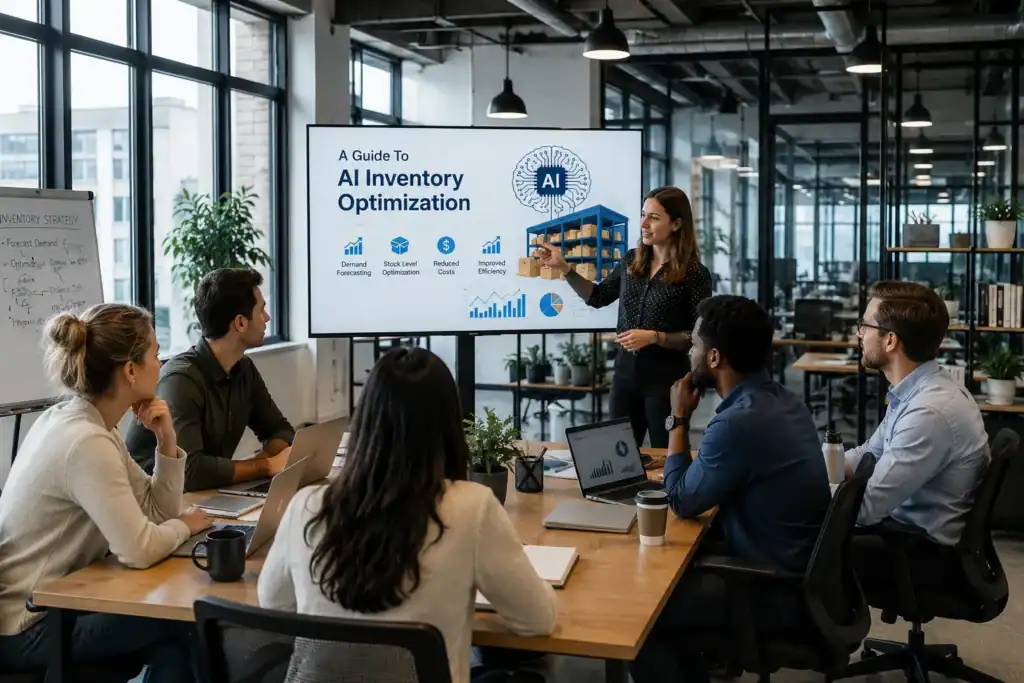
Ask a plant manager where the money’s hiding, and most of them can point straight at the warehouse. Rows of raw materials bought against a forecast that missed. Work-in-progress stacked up waiting on the one component that’s somehow both overstocked and unavailable. Finished goods aging on a shelf because a promotion slipped a quarter.
AI inventory optimization is the practice of using machine learning to set those stocking decisions from live signals instead of static rules, and for manufacturers specifically, it’s a lot less exotic than the pitch decks make it sound.
Worth saying out loud before we go further: this isn’t about predicting the future perfectly. It’s about being less wrong, more often, in the exact spots where being wrong is expensive.
What is AI inventory optimization for manufacturers?
For a manufacturer, inventory isn’t one thing. It’s raw materials feeding the line, work-in-progress moving through it, and finished goods waiting to ship, each with its own carrying cost and its own way of going sideways. AI inventory optimization looks at all three together and continuously adjusts what to hold, where, and when to reorder, based on demand forecasting, lead-time variability, and production schedules rather than a number someone set in a spreadsheet two years ago.
The practical version is quieter than the buzzword. It’s a model watching your actual consumption and delivery patterns, then flagging where your safety stock is protecting you and where it’s just parking cash.
How is this different from traditional inventory management software?
Traditional systems are very good at telling you what happened. You had 4,000 units, you used 3,200, here’s the count. They enforce the rules you gave them, which is exactly the problem: the rules are static, and your supply chain isn’t.
AI inventory optimization changes the input, not the interface. Instead of a fixed reorder point and a fixed safety-stock buffer, the reorder logic can account for seasonality, supplier reliability, and demand swings, allowing reorder points and safety-stock targets to adjust as conditions change. You’re not replacing the system that tracks inventory. You’re making the decisions it drives a lot smarter.
Why does inventory tie up so much working capital in manufacturing?
Because every buffer is a bet, and manufacturers place a lot of bets. Long lead times on raw materials push you to over-order so the line never stops. Multi-stage production means a delay at one station strands inventory at three others. And nobody gets fired for having too much, whereas a stockout shuts down a shift. So the safe move, over and over, is to hold more.
That instinct is rational. It’s also how you end up with a warehouse full of working capital you can’t spend on anything else.
What happens when reorder points are based on guesswork?
You get both problems at once. Overstock on the SKUs where someone padded the number to be safe, and stockouts on the ones where the pattern quietly shifted and nobody updated the formula. Guesswork doesn’t fail loudly. It fails as a slow drip of carrying costs and expedited-freight charges that never quite add up to an alarm.
How does AI actually optimize inventory levels?
It reads the signals you already generate and turns them into a reorder decision. Consumption rates, supplier lead times and how much they vary, production plans, open orders. The model uses those to forecast demand at the SKU level and set reorder points and safety stock that flex with reality instead of sitting still.
How do you apply this across raw materials, WIP, and finished goods?
Differently, on purpose, because they fail differently. Raw materials are mostly a lead-time and supplier-reliability problem, so the model leans on delivery variability. Work-in-progress is a flow problem, so it watches for the bottleneck that’s about to strand everything behind it. Finished goods are a demand problem, so it leans on forecasting and promotion timing. Same engine, three different questions.
How do you get started without replacing your current systems?
You start with one painful category, not the whole operation. Pick the SKUs eating the most working capital or causing the most stockouts, prove the reorder logic works there, then widen it. That keeps the first result close and cheap, which matters more than a comprehensive rollout that takes a year to show anything.
Can AI inventory optimization work inside your existing ERP and Power BI setup?
Usually, yes, and that’s the point. The data you need already lives in your ERP, and if you’re running Power BI inventory dashboards, you’ve already done the hard part of getting it somewhere usable. The optimization layer sits on top of what you have. No rip-and-replace, no new platform to learn, just better decisions coming out of the systems your team already trusts.
What results should you expect from AI inventory optimization?
Lower carrying costs from holding less excess stock, fewer stockouts on the components that actually stop production, and freed-up cash that was sitting in safety stock you didn’t need. The exact return depends on where you start, which is why the first use case should be tied to a problem you can already measure.
How long does it take to see a return?
P3 Adaptive works on a two-week guarantee, so the goal is a working result fast. Start with one inventory category, use the data you already have, prove whether better reorder decisions create value, then build from there.
If you’d rather not figure out where to start alone, that’s the kind of contained, fast-moving problem P3 Adaptive is built to solve. Talk to us about your inventory data, and we’ll help you find the first win worth chasing.
About the author
 Kristi Cantor
A business intelligence and analytics practitioner whose subject is what Power BI, Fabric and the current crop of AI tools actually do once they meet a real company’s data. She writes most of what P3 publishes about them.